

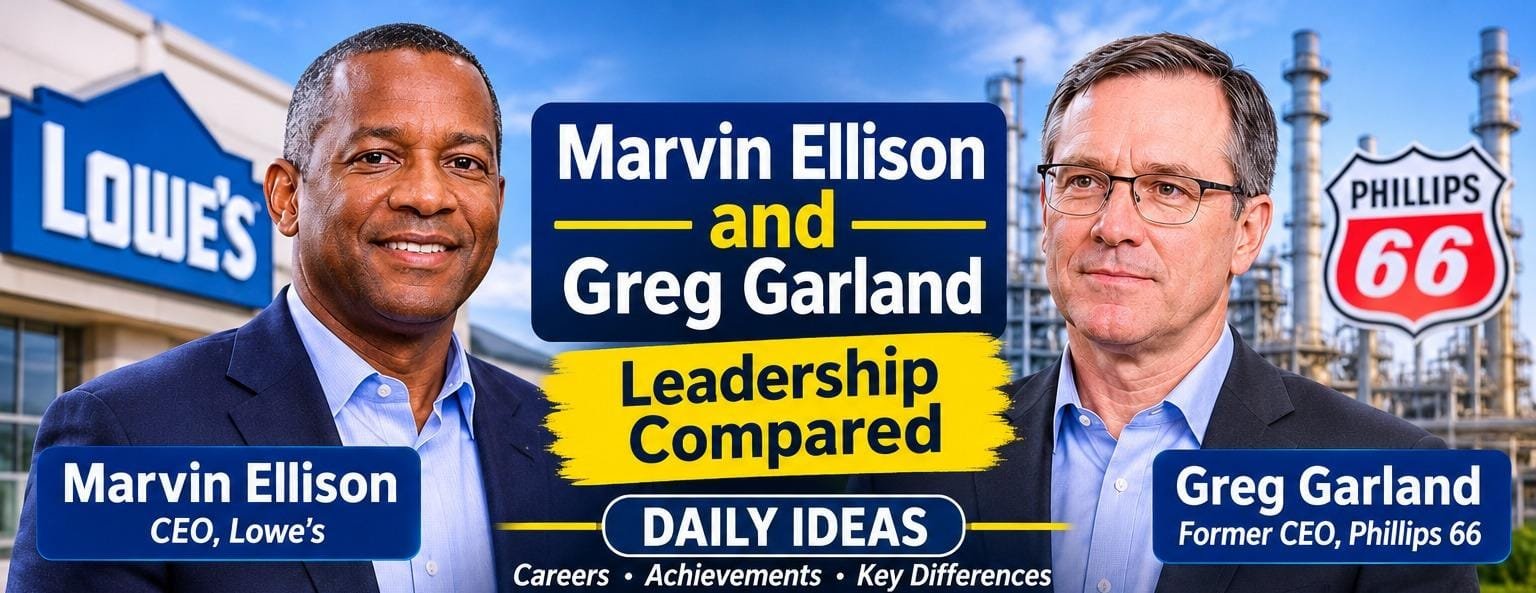
When people search for Marvin Ellison and Greg Garland, they may want to understand who these business leaders are, what companies they have worked for, and whether they share a professional or personal connection. Both names belong to experienced American corporate executives who have held influential positions in major companies. However, their careers developed in different industries and followed distinct paths.
Marvin Ellison is widely recognized for his leadership in the retail industry, particularly through his position at Lowe’s Companies, Inc. His professional background also includes senior roles at The Home Depot, Target, and J.C. Penney. Greg Garland, meanwhile, built his reputation in the energy sector through decades of experience at Phillips 66, ConocoPhillips, and Chevron Phillips Chemical.
Although their professional journeys offer interesting comparisons, it is important to distinguish documented facts from assumptions. Understanding their backgrounds, business experience, and leadership responsibilities provides a clearer picture of why these executives attract attention.
Who Are Marvin Ellison and Greg Garland?
Marvin Ellison and Greg Garland are American business executives known for their experience managing large organizations. Their careers demonstrate how professional expertise in different industries can lead to senior corporate leadership positions.
Ellison developed his career around retail operations, customer experience, logistics, and business development. Garland established his professional reputation in energy production, chemicals, industrial operations, and corporate management.
Here is a quick overview of their professional backgrounds:
| Profile Detail | Marvin Ellison | Greg Garland |
|---|---|---|
| Full Name | Marvin R. Ellison | Greg C. Garland |
| Main Industry | Retail and home improvement | Energy and chemicals |
| Best-Known Company | Lowe’s | Phillips 66 |
| Major Leadership Position | Chairman and CEO of Lowe’s | Former Chairman and CEO of Phillips 66 |
| Previous Companies | Target, Home Depot, J.C. Penney | Phillips Petroleum, Chevron Phillips Chemical, ConocoPhillips |
| Education | University of Memphis and Emory University | Texas A&M University |
| Professional Strength | Retail operations and business strategy | Energy operations and corporate leadership |
Their professional backgrounds reveal two different approaches to managing large businesses. One focuses on consumer retail and the home improvement market, while the other involves complex energy operations and industrial infrastructure.
Marvin Ellison: Career, Background, and Leadership
Marvin R. Ellison is an established American business executive recognized for his extensive experience in the retail industry. His career includes leadership responsibilities at several major American retailers, giving him experience in store management, logistics, customer service, and corporate operations.
He became particularly well known after joining Lowe’s, where he took responsibility for leading one of America’s largest home improvement retailers.
Early Career and Professional Development
Ellison developed his professional experience through operational positions at Target Corporation. He spent approximately 15 years with the company, working in different roles and gaining valuable knowledge of retail management.
In 2002, he joined The Home Depot, another major company in the home improvement industry. During his time there, he held several senior positions, including responsibilities involving logistics, loss prevention, regional operations, and U.S. store management.
These experiences helped him understand the challenges of operating large retail networks. Managing stores, improving distribution systems, supporting employees, and maintaining customer satisfaction became important parts of his professional background.
Leadership at J.C. Penney and Lowe’s
Before joining Lowe’s, Ellison served as president and chief executive officer of J.C. Penney. He became CEO in 2015 and chairman in 2016, remaining with the company until 2018.
In May 2018, Lowe’s announced his appointment as president and CEO, effective July 2 of that year. In June 2021, the company’s board elected him chairman.
His responsibilities at Lowe’s include overseeing the company’s broader business direction, retail operations, customer experience, and long-term strategy.
As chairman, president, and CEO, he occupies an important leadership position within the organization.
Education and Business Qualifications
Education has also played a role in Ellison’s professional development. He earned a Bachelor of Business Administration degree from the University of Memphis and an MBA from Emory University’s Goizueta Business School.
His academic background, combined with decades of practical retail experience, provides a foundation for his work in corporate leadership.
His career demonstrates how operational knowledge, business education, and experience across different companies can support progression into executive management.
Greg Garland: Career, Background, and Business Achievements
Greg C. Garland is an American corporate executive best known for his leadership in the energy industry. His professional career spans several decades and includes significant responsibilities at Phillips 66 and other energy-related organizations.
Unlike Ellison, whose experience centers on retail businesses, Garland developed his expertise in industrial operations, petroleum, chemicals, and energy markets.
Early Career in the Energy Industry
Garland began his professional journey at Phillips Petroleum Company in 1980. Over the following years, he gained experience in different areas of the energy business.
His career progressed through positions involving planning, specialty chemicals, strategic transactions, and corporate management.
He later held senior leadership responsibilities at Chevron Phillips Chemical Company, where he served as president and CEO from 2008 to 2010.
Following that position, he joined ConocoPhillips in a senior role involving exploration and production activities in the Americas.
These experiences helped him develop a broad understanding of energy operations and the business decisions required to manage large industrial organizations.
Leadership at Phillips 66
Greg Garland became one of the most recognizable leaders in the energy industry through his work at Phillips 66.
He served as chairman and CEO of the company from 2012 until June 2022. He subsequently became executive chairman, a position he held until May 2024.
During his leadership career, he was involved in overseeing a diversified energy business with activities across refining, chemicals, midstream operations, and related markets.
His experience included managing large-scale industrial operations, navigating changing energy markets, and addressing business challenges involving investment, production, and corporate strategy.
Education and Professional Experience
Garland studied chemical engineering at Texas A&M University. His technical educational background is relevant to his long career in petroleum, chemicals, and energy-related businesses.
A combination of engineering knowledge and executive experience helped him progress through increasingly senior positions.
His career also extended beyond Phillips 66. According to ExxonMobil’s corporate biography, he joined its board of directors in November 2025 as an independent director, bringing extensive experience in energy operations, corporate governance, and business management.
Marvin Ellison and Greg Garland: How Do Their Careers Compare?
One of the most interesting aspects of Marvin Ellison and Greg Garland is the difference between their professional backgrounds.
Both executives have managed major corporate responsibilities, but their industries require different types of knowledge, operational systems, and business strategies.
The following comparison highlights their main differences.
| Comparison Area | Marvin Ellison | Greg Garland |
|---|---|---|
| Industry Focus | Retail and home improvement | Energy and chemicals |
| Career Foundation | Store operations and logistics | Engineering and energy operations |
| Major Company | Lowe’s | Phillips 66 |
| Previous CEO Experience | J.C. Penney | Chevron Phillips Chemical |
| Business Environment | Consumer-focused markets | Industrial and energy markets |
| Key Expertise | Customer experience, retail strategy, supply chains | Energy operations, industrial strategy, corporate governance |
| Education | Business administration and MBA | Chemical engineering |
Different Industries, Different Responsibilities
Retail companies operate in a competitive environment where customer preferences, product availability, pricing, and shopping experiences influence business performance.
For Ellison, understanding customer expectations and improving retail operations have been important elements of his professional responsibilities.
Energy companies face a different set of challenges. Their operations involve infrastructure, production systems, regulatory requirements, commodity markets, and long-term investment decisions.
Garland’s experience reflects the complexity of managing businesses in this environment.
Despite these differences, both careers demonstrate the importance of strategic planning, operational knowledge, and effective organizational management.
Similarities in Their Leadership Experience
Although their professional paths are different, several similarities stand out.
- Extensive industry experience: Both executives developed their careers over many years before reaching senior leadership positions.
- Large organizational responsibilities: Their leadership roles involved overseeing major businesses with complex operations and numerous employees.
- Strategic decision-making: Both careers required decisions concerning business performance, operational efficiency, investment, and long-term planning.
- Corporate governance: Their experience includes responsibilities connected to company boards and executive leadership.
- Adaptability: Both executives worked through different professional responsibilities and changing business environments during their careers.
These similarities help explain why their professional backgrounds can be compared even though they do not share the same industry.
Are Marvin Ellison and Greg Garland Business Partners?
A common question behind the search for Marvin Ellison and Greg Garland is whether the two executives have worked together or share a direct business relationship.
Their publicly documented professional biographies do not establish a direct business partnership, joint venture, or shared executive position.
Ellison’s career is primarily associated with Target, The Home Depot, J.C. Penney, and Lowe’s. Garland’s professional background is connected to Phillips Petroleum, Chevron Phillips Chemical, ConocoPhillips, and Phillips 66.
Their executive careers can be compared because both have held influential positions in major American corporations. However, that similarity should not be interpreted as evidence that they have jointly managed a company or participated in a specific business project.
When investigating a possible relationship between corporate executives, reliable evidence should come from sources such as:
- Official company announcements.
- Corporate board membership records.
- Annual reports and regulatory filings.
- Verified business partnerships or joint venture announcements.
- Credible news coverage identifying a specific collaboration.
This approach helps separate documented professional relationships from assumptions based only on search results.
What Can Business Professionals Learn From Their Careers?
The professional journeys of Ellison and Garland offer useful lessons for people interested in management, business development, and corporate leadership.
Their careers show that executive success can emerge from different educational backgrounds and professional experiences.
1. Build Strong Industry Knowledge
Understanding an industry is essential for making informed business decisions. Ellison developed his expertise through years of retail operations, while Garland gained extensive experience in energy and industrial businesses.
Both examples demonstrate the value of learning how an organization works before taking responsibility for its broader direction.
2. Develop Practical Management Skills
Leadership requires more than an impressive job title. Managers must understand employees, operations, financial performance, customer needs, and organizational priorities.
Practical experience can help professionals make better decisions when they eventually move into senior positions.
3. Adapt to Changing Business Conditions
Companies regularly face changes in technology, competition, consumer expectations, and market conditions.
Executives must evaluate these developments and adjust their strategies without losing sight of long-term objectives.
4. Combine Education With Experience
Formal education can provide useful business and technical knowledge, but practical experience helps professionals apply that knowledge to real organizational challenges.
The different educational backgrounds of Ellison and Garland illustrate that there is no single academic route to corporate leadership.
5. Think Beyond Short-Term Performance
Successful corporate management involves balancing immediate business needs with long-term stability.
This includes investing in people, improving operational systems, managing risks, and preparing organizations for future challenges.
Frequently Asked Questions
1. Who are Marvin Ellison and Greg Garland?
Marvin Ellison is an American retail executive who serves as chairman, president, and CEO of Lowe’s Companies, Inc. Greg Garland is an energy-industry executive best known for his former leadership position as chairman and CEO of Phillips 66.
2. Are Marvin Ellison and Greg Garland related?
Their publicly available professional biographies do not establish a family relationship. Their names appearing together in online searches should not be treated as evidence that they are relatives.
3. Do Marvin Ellison and Greg Garland work for the same company?
No shared executive employment history is established in their public biographies. Ellison is associated with Lowe’s, while Garland’s most prominent executive leadership role was at Phillips 66.
4. What is Marvin Ellison best known for?
Marvin Ellison is best known for his retail leadership, particularly his position as chairman, president, and CEO of Lowe’s. He also held important executive positions at The Home Depot and J.C. Penney.
5. What was Greg Garland’s role at Phillips 66?
Greg Garland served as chairman and CEO of Phillips 66 from 2012 to June 2022. He later served as executive chairman until May 2024.
6. What are the educational backgrounds of Marvin Ellison and Greg Garland?
Ellison earned a bachelor’s degree in business administration from the University of Memphis and an MBA from Emory University. Garland studied chemical engineering at Texas A&M University.
7. What industries are Marvin Ellison and Greg Garland associated with?
Ellison is associated with retail, home improvement, and consumer business operations. Garland is associated with energy, petroleum, chemicals, and industrial management.
8. What makes their careers interesting to compare?
Their careers demonstrate two different routes to senior corporate leadership. Ellison developed his expertise through retail operations and customer-focused business management, while Garland built his experience through engineering, energy operations, and industrial leadership.
Conclusion
The professional stories of Marvin Ellison and Greg Garland offer an interesting look at leadership across two very different industries. Ellison built his reputation through retail management and his leadership at Lowe’s, while Garland established his position in the energy sector through decades of experience at Phillips 66 and other major companies.
Although their careers share similarities in executive responsibility and corporate experience, their publicly documented backgrounds do not establish a direct personal or business partnership. Understanding their individual achievements provides a more accurate picture of why both executives are recognized in American business.

